

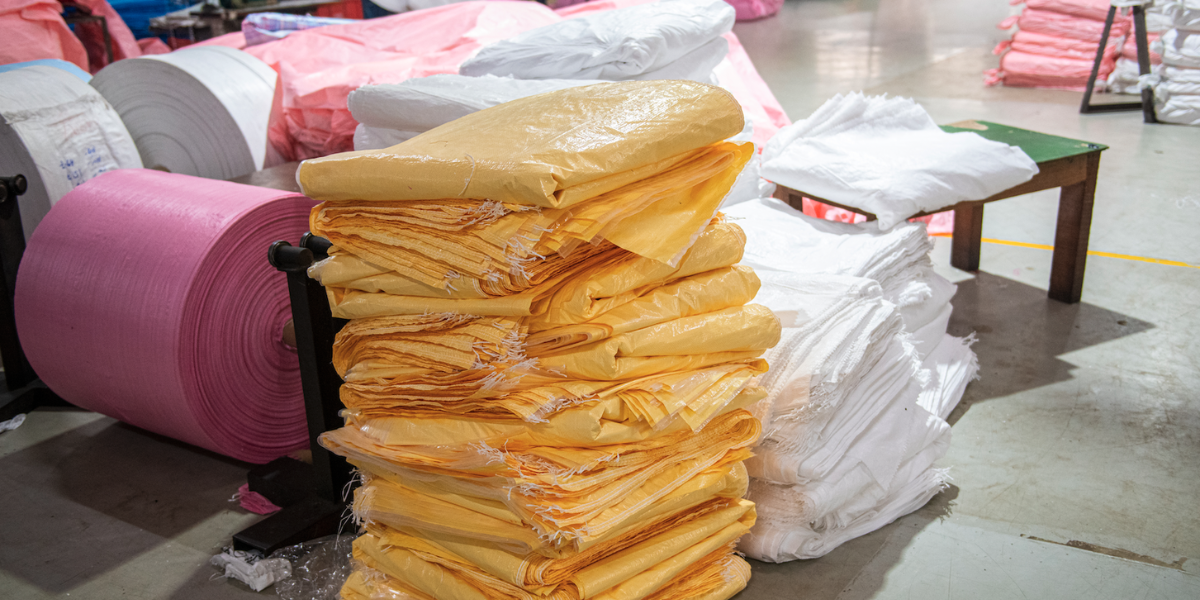
Woven poly sacks are the workhorse of Indian packaging because they are light, tough, printable, and recyclable. The two dominant choices—HDPE (High Density Polyethylene) and PP (Polypropylene)—look similar at first glance, but they behave differently in the real world. If you match the polymer to the job, you reduce product loss, improve handling, and save on total cost.
Material basics in plain language
HDPE tapes are stiffer, more waxy to the touch, and naturally better at resisting moisture ingress. PP tapes are tougher and more fatigue-resistant, with higher clarity for better print finishes when laminated. HDPE holds shape well for stackability. PP tolerates repeated flexing and rough handling without cracking. Both are chemically resistant and recyclable, and both can be UV-stabilised for outdoor exposure.
Where HDPE woven sacks shine
• Moisture-sensitive powders and hygroscopic granules that still need a breathable fabric before lamination.
• Sand, salt, and general construction fill where shape retention and stack stability matter.
• Short-haul agricultural uses where bags are stacked high under tarps or sheds.
• Lower-temperature environments and cool stores, because HDPE maintains stiffness at moderate cold.
Where PP woven sacks are a better bet
• Heavy 25–50 kg industrial packs for cement, clinker, minerals, fertilisers, and resins.
• Frequent handling, long road transport, or export where abrasion and seam stress are high.
• BOPP-laminated retail packs (grains, pulses, animal feed, seeds) that need strong graphics and scuff resistance.
• Valve and pinch-bottom styles where high drop strength and cleaner discharge are required.
Understanding load and safety
Think in working loads, not just “bag size.” A typical woven sack used in industry carries 25 or 50 kg; the true safety comes from fabric GSM/denier, weave, lamination, liner, seam type, and UV level. For 10–25 kg you can use lighter fabric (say 60–75 GSM) with single fold stitching. For 25–50 kg move to 80–110 GSM, tighter weave, and double fold stitching; laminated PP or PP with PE liner will control sifting and moisture. For over 50 kg, consider specialised heavy sacks or step up to FIBCs.
Moisture, sifting, and barrier choices
Moisture is often the real enemy. If the product cakes or loses strength when damp, choose one of these paths: HDPE or PP fabric with internal PE liner; PP fabric with BOPP lamination; PP fabric with extrusion coating. Liners offer the best vapour barrier and are cost-effective for powders. BOPP lamination delivers barrier plus premium print. For products that must “breathe” (freshly milled grains), use unlaminated PP with a tight weave and desiccants in transit.
Handling and abrasion
If bags will be dragged, double-stacked on rough pallets, or shipped long distances, PP generally survives better because it resists crack propagation around stitch holes and corners. Valve PP sacks for cement are industry standard for a reason: they combine fast filling, stable stacking, and high drop performance. For on-site sandbags or quarry fill where units are rarely re-handled after stacking, HDPE’s stiffness keeps cubes tidy and pallets stable.
Temperature and UV
Both polymers soften with heat and degrade under UV, but PP holds mechanical strength slightly better at typical Indian ambient temperatures. Outdoor storage is the bigger risk. If bags will sit in yards or at retail fronts, specify UV stabiliser in the fabric and stitching, and prefer lighter body colours with UV-fast inks. For monsoon exposure, use lamination or liners regardless of polymer.
Printing and branding
If shelf presence matters, PP with BOPP lamination produces sharper, glossier graphics and resists scuffing through distribution. HDPE can be surface printed, but large retail brands usually prefer the look and durability of BOPP-on-PP. For purely industrial flows with minimal retail touchpoints, plain or coated HDPE is a cost-sound choice.
Seams, bottoms, and closures
Seam design carries the load as much as the fabric does. For 25–50 kg loads, use double fold bottom with chain and lock stitches in high-tenacity thread. For free-flowing powders, consider valve bags or hemmed tops with heat-cut edges to prevent fray. Where contamination risk is high, choose pinch-bottom PP with hot-melt closure, or add a liner neck-tie.
A quick selector by application
• Cement, clinker, fly ash: PP valve sacks, 80–100 GSM, coated or laminated; UV stabilised for yard storage.
• Fertiliser (urea, DAP): PP laminated or PP with PE liner; strong seams for 50 kg; anti-slip finish for stacking.
• Minerals and ores (silica, dolomite, bauxite fines): PP 90–110 GSM, coated or lined; abrasion-resistant.
• Food grains and pulses: PP, often BOPP laminated for retail; consider micro-perforation if needed to breathe.
• Sugar and salt: PP or HDPE with liner depending on humidity; prefer laminated PP for coastal routes.
• Sandbags, construction fill: HDPE unlaminated, stiffer body for stack form; UV treated for outdoor piles.
• Animal feed and seed: PP with BOPP lamination for shelf appeal and scuff resistance; EZ-open stitching.
Testing that matters
Do not buy only on GSM. Ask for and verify: drop test at target load, seam strength, tear resistance, burst pressure (for coated/laminated), coefficient of friction for stacking, UV hours in accelerated weathering, and migration/food-contact compliance where relevant. A reputable supplier will show batchwise QC and traceability.
Cost and sustainability
On a per-bag basis, HDPE can be marginally cheaper for simple, unlaminated sacks; PP costs a little more when you add coatings and BOPP prints, but can lower total system cost by reducing damage, sifting, and claims. Both materials are widely recyclable; specify mono-material designs where possible, use solvent-free lamination options, and request recycled-content tapes where regulations and performance allow.
Decision framework you can use today
Define the load and drop height. Define the moisture risk and journey length. Decide whether branding or purely functional service is needed. If loads are 25–50 kg, journeys are long, and scuffing is likely, start with PP (coated or laminated) and tune from there. If the application is static stacking, fill materials, or short-haul under cover, HDPE can deliver value with fewer extras. Always run a small pilot with real product before scaling.
Why partner with Creative Ecotech
If you want the choice made easy, Creative Ecotech can engineer the sack to your exact use case: HDPE and PP woven bags, BOPP-laminated retail sacks, liners for moisture-sensitive powders, UV-stabilised outdoor bags, anti-slip coatings, and EZ-open closures. Every order is backed by QC for drop, seam, tear, and UV, with print options tuned to your brand and supply chain. Share your product, load, and route; Creative Ecotech will recommend the right construction, sample quickly, and scale reliably so your product arrives intact and your costs stay predictable.
For further information, you can communicate with us at 033-40010135 and get solutions to your questions. Apart from that, you can visit our office located at Ecostation Building, Saltlake, Sector V, Kolkata to have a face-to-face discussion with us. Also, visit our official website to witness the services we deliver. Let’s work together to make plastic production more responsible and planet-friendly.


