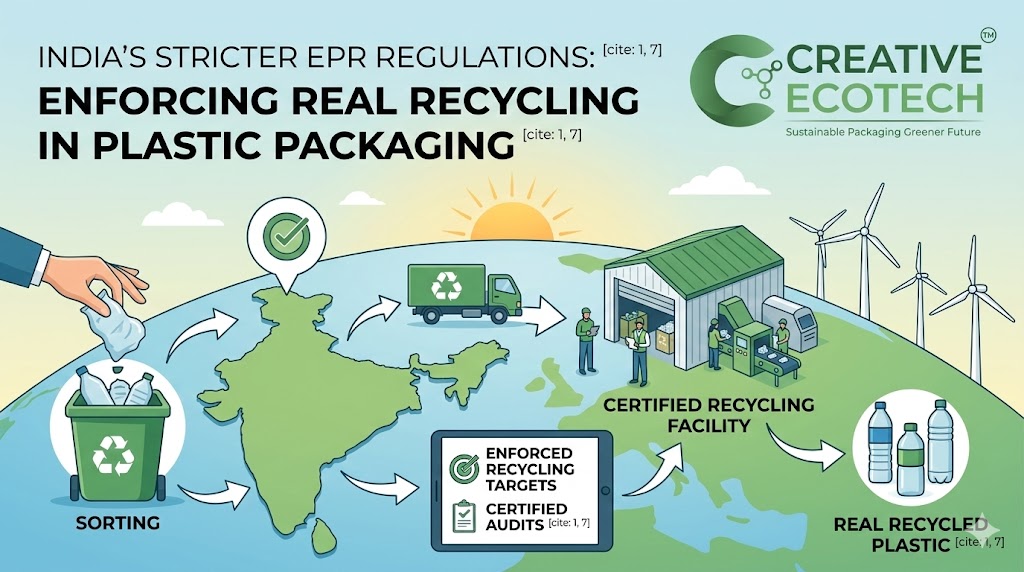
India is taking decisive action against plastic pollution. With the introduction and tightening of Extended Producer Responsibility (EPR) regulations for plastic packaging, the country is shifting from policy intent to measurable enforcement.
For producers, importers, brand owners (PIBOs), and plastic processors, compliance is no longer just a documentation exercise — it now demands real recycling, verified traceability, and accountability.
Here’s what India’s stricter EPR framework means and how it is transforming plastic waste management.
Understanding Extended Producer Responsibility (EPR)
Extended Producer Responsibility (EPR) makes producers responsible for the environmental impact of their products throughout the product lifecycle — especially post-consumer waste.
In India, EPR for plastic packaging is governed under:
- Plastic Waste Management (PWM) Rules
- EPR Guidelines issued by the Central Pollution Control Board (CPCB)
- Online EPR portal for tracking compliance
Under these regulations, Producers, Importers, and Brand Owners (PIBOs) must:
- Register on the CPCB EPR portal
- Meet annual recycling targets
- Ensure environmentally sound disposal of plastic waste
- Use certified recyclers
- File periodic compliance reports
The focus has shifted from collection claims to verifiable recycling outcomes.
What Makes India’s EPR Regulations Stricter?
India’s updated EPR framework introduces stronger compliance mechanisms and higher accountability standards.
1. Mandatory Recycling Targets
Companies must fulfill annual recycling obligations based on the volume and category of plastic packaging they introduce into the market.
Plastic packaging is categorized into:
- Rigid plastic
- Flexible plastic
- Multi-layered plastic
- Compostable plastics
Each category has defined recycling or end-of-life disposal targets — and these targets increase progressively over time.
2. EPR Certificates and Traceability
A major reform is the introduction of EPR certificates issued by registered recyclers.
Recyclers generate certificates based on actual recycling performed. PIBOs must purchase these certificates to meet their obligations. This creates:
- A formal recycling marketplace
- Digital traceability
- Accountability through the CPCB portal
This system discourages paper-based compliance and fake documentation.
3. Environmental Compensation for Non-Compliance
Companies failing to meet their EPR targets face environmental compensation (EC) penalties.
These penalties:
- Increase with non-compliance severity
- Act as a financial deterrent
- Can affect business operations and brand reputation
Regulators are actively monitoring compliance, signaling a shift toward stricter enforcement.
4. Focus on Recycled Content Usage
The rules also mandate the use of minimum recycled plastic content in certain packaging categories.
This measure supports:
- Demand creation for recycled materials
- Strengthening of domestic recycling markets
- Reduction in virgin plastic consumption
It pushes companies toward a circular economy model rather than a linear take-make-dispose system.
Why India’s EPR Model Matters Globally
India is one of the world’s largest plastic-consuming economies. By strengthening plastic waste policy, the country:
- Encourages formalization of the recycling sector
- Integrates informal waste workers into structured systems
- Promotes sustainable business practices
- Aligns with global sustainability goals and the emerging UN Plastics Treaty framework
India’s model could become a benchmark for other developing economies seeking scalable recycling enforcement.
Impact on Businesses and Plastic Packaging Industry
Stricter EPR regulations significantly impact stakeholders across the value chain.
For Producers and Brand Owners
- Increased compliance costs
- Need for supply chain transparency
- Greater documentation and reporting requirements
- Strategic shift toward recyclable packaging design
Businesses must now treat EPR as a core operational function, not just a compliance formality.
For Recyclers and Waste Processors
- Growth in demand for certified recycling
- Formal market access through EPR certificates
- Incentives for capacity expansion and technology upgrades
This strengthens India’s recycling ecosystem and encourages infrastructure investment.
For Sustainability Leaders
India’s EPR enforcement supports:
- Plastic footprint reduction
- ESG reporting improvements
- Corporate sustainability commitments
- Zero waste goals
Companies aligning early gain competitive advantage and regulatory security.
Challenges in Implementation
While India’s stricter EPR framework is progressive, challenges remain:
- Inconsistent data reporting
- Limited recycling infrastructure in certain regions
- Monitoring authenticity of recycling claims
- Integration of informal waste workers
- Administrative complexity for SMEs
Effective enforcement requires robust digital systems, stakeholder training, and transparent auditing mechanisms.
Moving from Compliance to Circular Economy
India’s strengthened EPR regulations are more than just waste management rules — they are a foundation for a circular economy in plastic packaging.
To succeed under this framework, businesses should:
- Conduct plastic footprint assessments
- Redesign packaging for recyclability
- Partner with certified recyclers
- Invest in recycled material sourcing
- Digitize compliance tracking systems
The focus must shift from “How do we comply?” to “How do we eliminate waste and design better systems?”
The Road Ahead
India’s stricter EPR regulations signal a clear message: recycling must be real, measurable, and accountable.
As enforcement intensifies and targets rise, companies that proactively adapt will:
- Reduce regulatory risks
- Strengthen brand credibility
- Improve operational efficiency
- Contribute meaningfully to solving plastic pollution
Plastic packaging reform in India is no longer a policy discussion — it is an operational reality.
The future belongs to businesses that embrace transparency, innovation, and circularity.
The Road Ahead: From Enforcement to Circular Economy
India’s stricter EPR regulations signal a clear shift — real recycling, real accountability, and real impact.
As enforcement intensifies, businesses must evolve from compliance-driven operations to circular design thinking.
With expert guidance, digital transparency, and sustainability innovation, companies can not only meet EPR obligations but also become leaders in responsible plastic packaging.
Creative EcoTech stands ready to guide businesses through this transformation — helping turn regulatory mandates into sustainable growth opportunities.
Partner with us to support ethical manufacturing. Contact Creative Ecotech to learn more about how we embed fairness and safety into every layer of our business. Let’s build a more responsible and sustainable future—together.
For further information, you can communicate with us at 033-40010135 or send mail to admin@creativeecotech.com and get solutions to your questions. Apart from that, you can visit our office located at Ecostation Building, Saltlake, Sector V, Kolkata to have a face-to-face discussion with us. Also, visit our official website to witness the services we deliver. Let’s work together to make plastic production more responsible and planet-friendly.
Partner with us to support ethical manufacturing. Contact Creative Ecotech to learn more about how we embed fairness and safety into every layer of our business. Let’s build a more responsible and sustainable future—together.
For further information, you can communicate with us at 033-40010135 or send mail to admin@creativeecotech.com and get solutions to your questions. Apart from that, you can visit our office located at Ecostation Building, Saltlake, Sector V, Kolkata to have a face-to-face discussion with us. Also, visit our official website to witness the services we deliver. Let’s work together to make plastic production more responsible and planet-friendly.